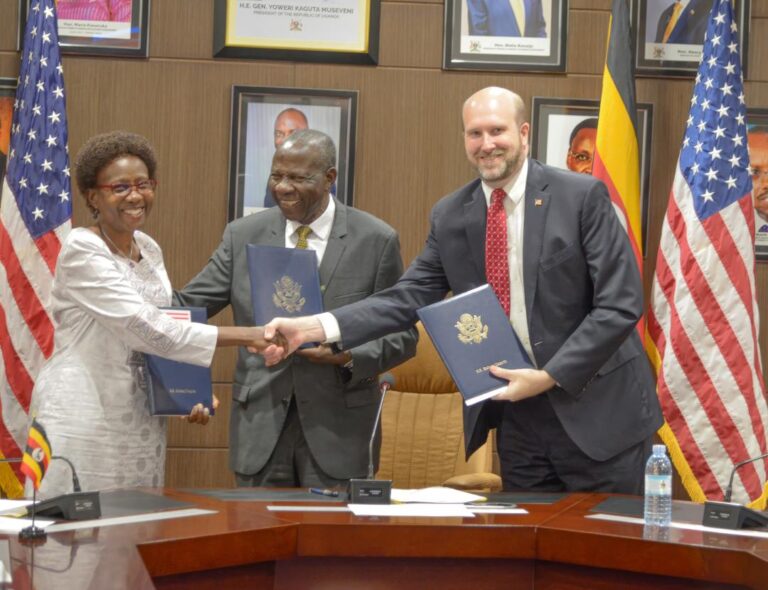
The United States and Uganda have signed a new five-year, $2.3 billion health cooperation agreement aimed at strengthening Uganda’s health system and improving global disease prevention. The deal deepens the relationship between the two governments and sets a path for Uganda to build a more resilient system that can quickly respond to outbreaks.
The United States plans to channel up to $1.7 billion into key areas such as HIV/AIDS, TB, malaria, maternal and child health, polio eradication, global health security, and disease surveillance. Uganda has committed to raise its own health spending by more than $500 million over the same period. The agreement also includes support for faith-based healthcare providers, who often handle care in hard-to-reach communities.
Speaking at the signing, U.S. Ambassador William W. Popp said, “This agreement represents a significant commitment by the United States and Uganda to co-invest in our shared global health priorities.”
He noted that the two countries were building on years of cooperation. “Today, we are building on prior successes and making a significant shift toward promoting self-reliance in the health sector through strong community health systems, clear performance metrics, and a foundational commitment to data systems and global health security that will prevent and stop outbreaks from threatening Uganda, the United States and the world.”
Finance Minister Matia Kasaija welcomed the partnership and emphasized Uganda’s responsibility in strengthening its own system. “The Government of Uganda acknowledges the critical importance of preventing the spread of emerging and existing infectious disease threats globally,” he said.
Youmight also like




Kasaija pointed to the financial commitments laid out in the new framework. “In this regard, the Government of Uganda notes the United States Government’s commitment to support Uganda with a budget allocation of $1.7 billion for the period 2026–2030,” he said.
He added that Uganda was prepared to steadily step up its own investment. “The Government of Uganda also recognizes and commits to gradually increasing its own budgetary contribution to more than $500 million over the same period, as the U.S. budget support decreases.”
According to the minister, the agreement is expected to deliver results beyond single-disease programs. “This collaboration will yield not only disease-specific outcomes but also significant improvements in national systems, institutions, and workforce capacity,” he said.